
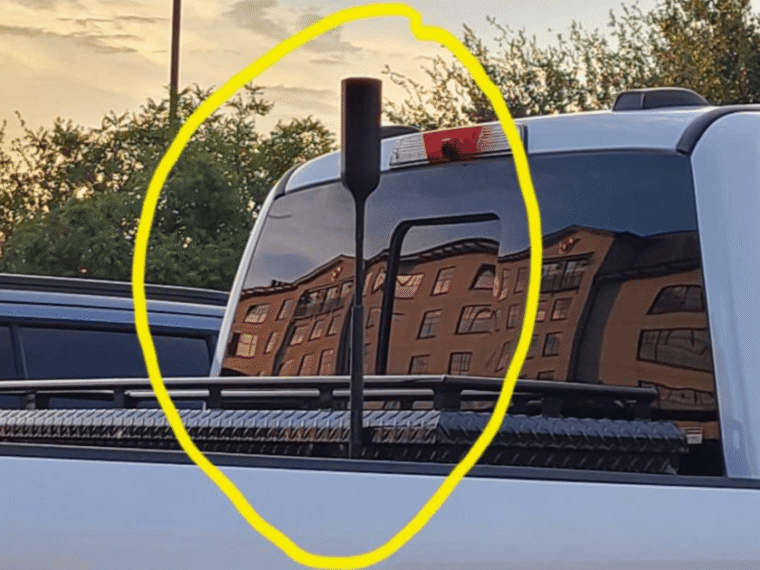
This is another group that frequently benefits from vehicle-mounted antennas.
Camping and overlanding often involve traveling far away from cities and major highways.
You might spend the day exploring a forest road, desert trail, mountain route, or remote campsite. In those environments, cellular coverage can vary dramatically from one location to another.
A vehicle booster can help when there is a weak signal available but the phone struggles to maintain a reliable connection.
For example, a manufacturer of vehicle boosters describes the typical system as an outside antenna capturing a weak cellular signal, an amplifier strengthening it, and an inside antenna distributing the improved signal to devices inside the vehicle.
But there is an important limitation.
No cellular booster can create a cellular network where there is genuinely no cellular signal to receive.
If you’re deep inside a remote mountain valley with no usable signal from your carrier, the antenna won’t suddenly connect your phone to a tower hundreds of miles away.
In a weak-signal area, however, the difference can be meaningful.
Does a Bigger Antenna Always Mean Better Signal?
Not necessarily.
It is tempting to look at a tall antenna and assume that taller automatically means better.
In reality, performance depends on many factors, including the antenna design, frequency bands supported, mounting position, distance from the cellular tower, terrain, surrounding structures, and the strength of the original signal.
The height of an antenna can be useful in certain installations, but it isn’t a magic formula.
A professionally designed system is about the entire setup—not simply the size of the rod sticking out of the truck.
What If the Truck Has a CB Radio?
This is where things can get confusing.
Some pickup trucks really do have external antennas for CB radios, amateur radio equipment, or other communication systems.
A CB antenna and a cellular booster antenna can look surprisingly similar from a distance.
That’s why you shouldn’t automatically assume that every tall rod on a truck is a cell phone booster.
The equipment’s location, antenna style, cables, and what is installed inside the vehicle can provide clues, but you often can’t identify the exact purpose simply by looking at the antenna.
If the truck belongs to a long-haul driver, construction worker, off-road enthusiast, or radio hobbyist, there are several possible explanations.
Why You Sometimes See Very Tall Antennas
Some vehicle cellular systems use an antenna mast or extension that raises the antenna above the vehicle.
The purpose isn’t simply to make the truck look more impressive.
The goal is to position the antenna where it can communicate more effectively with available cellular signals.
For specialized truck and over-the-road equipment, manufacturers offer exterior antennas designed specifically for large vehicles and remote travel. Some systems include adjustable or extended antenna mounts intended for semis and other rugged vehicles.
This is particularly useful for drivers who spend long periods on rural highways where cellular coverage may be patchy.
Does It Improve Phone Bars?
It can, but the number of bars on a phone isn’t a perfect measurement of connection quality.
Signal strength can be affected by the carrier, frequency band, tower congestion, terrain, and other factors.
Some manufacturers report improvements in signal bars under weak-signal conditions, but real-world performance varies considerably depending on location and network availability.
That’s why a booster shouldn’t be judged solely by whether the phone suddenly displays more bars.
The more meaningful question is whether the connection actually becomes more usable.
Can the driver complete a call without dropping?
Can a map load?
Can a message send?
Can a hotspot maintain a connection?
Those practical results matter more than the icon on the screen.
Why You Shouldn’t Put the Antennas Too Close Together
There is another interesting detail that many people never consider.
Vehicle signal boosters typically have an outside antenna and an inside antenna. These antennas need sufficient separation.
If they are positioned too close together, they can interfere with each other and create feedback, sometimes called oscillation.
Manufacturers design boosters with safeguards that can reduce power or shut the system down when this happens. Increasing the distance between the exterior and interior antennas can resolve the problem.
This is one reason proper installation matters.
Simply placing two antennas wherever they happen to fit isn’t necessarily enough.
Are Cell Signal Boosters Legal?
The answer depends on the country and the specific equipment.
In the United States, consumer signal boosters are regulated by the FCC. The FCC established rules allowing consumer boosters for locations such as cars, boats, and recreational vehicles while imposing technical requirements intended to prevent harmful interference with wireless networks.
The FCC also requires operation to comply with applicable rules, meaning consumers should use properly certified equipment and follow the relevant installation and operating requirements.
Rules can differ in other countries, so anyone installing a booster outside the United States should check the regulations applicable to their location.
Can a Signal Booster Work With Any Phone?
A properly designed cellular booster isn’t the same thing as a Wi-Fi repeater or Bluetooth accessory.
It communicates with cellular radio frequencies, and compatibility depends on the frequencies and networks supported by the particular equipment.
Many modern vehicle boosters are designed to support multiple cellular bands and multiple devices, but that does not mean every booster works identically with every carrier in every country.
Before purchasing one, drivers should check which network bands and technologies the device supports and whether it is approved for use in their country.
What About 5G?
Modern cellular boosters can support certain 5G bands, but “5G booster” does not automatically mean that every 5G frequency will be amplified.
5G uses multiple frequency ranges, and support varies between devices and carriers.
For example, current vehicle booster products are marketed with support for selected 4G LTE and 5G networks, while their actual performance depends on the frequencies available in the location.
If you’re considering buying a booster specifically for 5G, check the technical specifications rather than relying only on the word “5G” on the box.
What the Strange Pole Doesn’t Do
There are a few misconceptions worth clearing up.
That antenna doesn’t necessarily:
- Create cellular service from nothing.
- Guarantee a signal everywhere.
- Automatically connect to the nearest tower.
- Make every phone dramatically faster.
- Replace satellite communication.
- Guarantee emergency connectivity.
Its fundamental purpose is much simpler: improve the use of an existing cellular signal when conditions allow.
If there is no network coverage at all, a cellular booster cannot manufacture it.
That’s the key limitation to remember.
What If There Is Absolutely No Cell Service?
This is where satellite technology becomes different.
A cellular booster depends on terrestrial cellular towers.
A satellite communication system uses a completely different network architecture.
That means someone traveling into a genuine cellular dead zone may need a satellite-based communication or internet solution rather than a cellular booster.
The two technologies can also complement each other. A booster may be useful while traveling through areas with weak cellular coverage, while satellite connectivity can provide a separate option in places outside cellular coverage.
So, Is That Strange Pole Really a Cell Phone Antenna?
Sometimes, yes.
If you see a tall rod mounted on a pickup, especially on a work truck, overland vehicle, RV, or long-haul truck, there is a good chance it could be part of a cellular signal booster system.
But you can’t know for certain just by looking at it.
It could also be a CB antenna, amateur-radio antenna, or another type of communications equipment.
The important clue is the rest of the setup.
A cellular booster normally has an exterior antenna connected to an amplifier and an interior antenna, forming a system designed to strengthen two-way communication between devices inside the vehicle and the cellular network.
The Bottom Line
That strange pole sticking up behind a pickup truck isn’t necessarily some mysterious piece of old radio equipment.
In many cases, it’s an external cellular antenna, and it may be connected to a vehicle signal booster designed to improve weak cellular connections.
The technology is surprisingly straightforward:
Outside antenna → amplifier → inside antenna → improved cellular connection.
The system doesn’t create coverage where none exists, but when a usable signal is available, an external antenna can give the booster a better way to communicate with the cellular network.
That makes these systems particularly useful for truckers, contractors, campers, rural workers, overlanders, and anyone who regularly travels through areas where cell service is weak or inconsistent.
So the next time you pass a pickup with a ridiculously tall antenna sticking out behind the cab, don’t automatically assume it’s just a radio.
There might be a driver back there doing something very modern: trying to keep a cell phone connected when the nearest reliable signal is far away.