
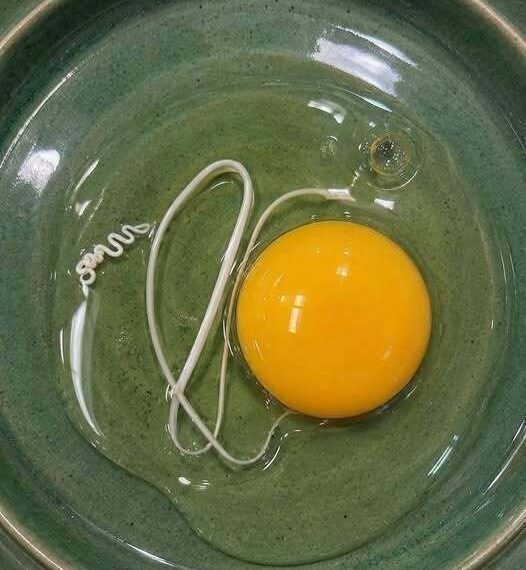
You crack open an egg and notice a strange white strand attached to the yolk. It almost looks like a tiny rope or a piece of membrane.
Should you remove it? Does it mean the egg has gone bad? Is it an embryo or something abnormal?
Not at all.
That white strand has a specific name: the chalaza. It is a completely natural part of the egg, perfectly safe to eat, and it plays an important role by helping keep the yolk centered within the egg white.
Even more interesting, a clearly visible and well-defined chalaza is often associated with a fresher egg and better internal quality.
What Is the Chalaza?
The chalaza is a white, twisted, rope-like structure found on either side of the egg yolk.
It is made primarily of egg-white proteins and serves to hold the yolk in a relatively central position inside the egg.
The chalaza acts as a natural anchor, keeping the yolk suspended while protecting it from excessive movement.
So if you notice a prominent white strand attached to the yolk, it is:
✅ Not a worm
✅ Not a vein
✅ Not a piece of shell
✅ Not an embryo
✅ Not a sign of contamination
It is simply a normal and healthy part of the egg.
What Is the Purpose of the Chalaza?
Imagine the yolk as a small ball floating inside liquid.
Without support, it would move around freely and could be damaged more easily.
The chalazae, which are located on opposite sides of the yolk, function like tiny suspension cables that help keep the yolk centered within the egg white.
This structure is part of the egg’s sophisticated natural design and helps protect the yolk throughout storage and development.
Why Can a Visible Chalaza Indicate a Fresh Egg?
This is perhaps the most surprising fact about the chalaza.
As an egg ages, its internal structure gradually changes.
Over time:
- The egg loses moisture.
- Carbon dioxide slowly escapes through the shell.
- The egg white becomes thinner.
- The yolk becomes flatter and more fragile.
- The chalaza becomes less noticeable.
Because of these changes, a thick, bright white, clearly visible chalaza is often a sign that the egg is relatively fresh.
What Happens as an Egg Ages?
Fresh Egg
🥚 Firm, thicker egg white
🥚 Rounder, higher yolk
🥚 Strong, visible chalaza
🥚 Yolk stays well centered
Older Egg
🥚 Thinner, more watery egg white
🥚 Flatter yolk
🥚 More fragile yolk membrane
🥚 Less visible chalaza
🥚 Yolk moves more easily inside the egg
These natural changes occur as moisture and carbon dioxide gradually escape through the microscopic pores of the shell.
Other Signs of a Fresh Egg
The chalaza is not the only indicator of freshness.
1. A Thick Egg White
When a fresh egg is cracked onto a plate, the thicker portion of the white stays close to the yolk rather than spreading out rapidly.
2. A High, Rounded Yolk
Fresh eggs usually have yolks that stand taller and appear more rounded.
Older eggs tend to have flatter yolks.
3. A Visible Chalaza
A noticeable white strand attached to the yolk is completely normal and often suggests good internal quality.
4. Slightly Cloudy Egg White
Many people assume that a cloudy egg white means something is wrong.
In reality, slightly cloudy egg whites are often associated with very fresh eggs.
Clearer whites may appear as the egg ages.
Does the Chalaza Mean There Is a Chick Inside?
Absolutely not.
One of the most common misconceptions is that the chalaza is the beginning of a developing chick.
The chalaza is simply a protein structure that exists in both fertilized and unfertilized eggs.
Most eggs sold in grocery stores are unfertilized, and the presence of a chalaza has nothing to do with embryo development.
Should You Remove the Chalaza?
The answer is entirely a matter of personal preference.
✅ It is perfectly safe to eat.
✅ It has no negative effect on flavor.
✅ It contains the same basic nutrients found in the egg white.
Some bakers remove it when preparing very smooth custards or delicate recipes, but for everyday cooking there is usually no reason to remove it.
The Bottom Line
✔️ The white string attached to the yolk is called the chalaza.
✔️ It is a natural and edible part of the egg.
✔️ Its job is to keep the yolk centered and protected.
✔️ A prominent chalaza is often a sign of a fresher egg.
✔️ It is not an embryo, a parasite, or a sign of spoilage.
What About You?
🥚 Option 1: I always wondered what that white string was.
🥚 Option 2: I used to remove it before cooking.
🥚 Option 3: I just learned something new about eggs today!
Share your answer in the comments and tell us whether you’ve ever noticed the chalaza in your eggs! 🍳🥚✨