
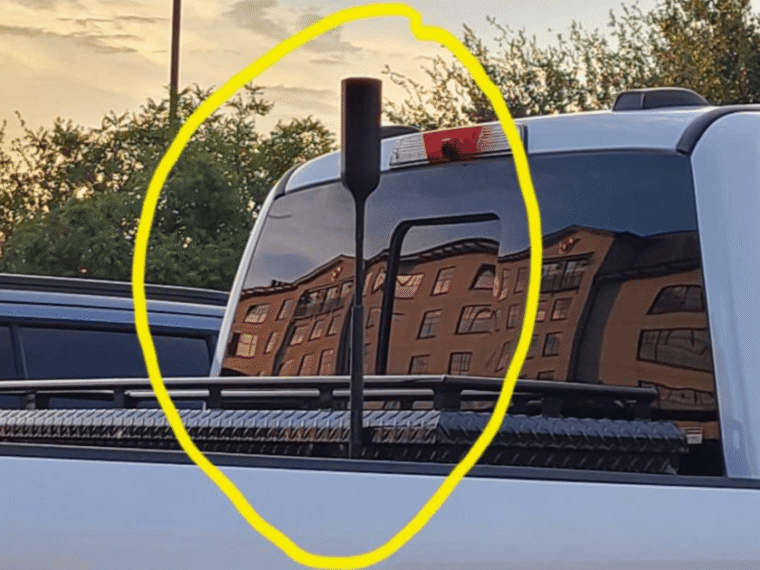
Have you ever been driving down a country road, passing trucks one after another, when you suddenly notice something unusual sticking up behind the cab?
It looks like a tall antenna. Sometimes it is mounted on the roof, sometimes behind the cab, and sometimes on a bracket attached to the truck bed. At first glance, you might assume it’s an old-fashioned radio antenna, a CB setup, or perhaps some specialized equipment used by construction workers.
But increasingly, that mysterious rod has a very modern purpose.
In many cases, it is part of a cell phone signal booster for trucks—a piece of equipment designed to improve cellular connectivity in areas where a phone has only a weak signal.
And once you understand what it does, the reason you see these antennas on work trucks, campers, off-road vehicles, and rural pickups starts to make a lot more sense.
What Is That Rod on the Back of the Truck?
That tall rod is typically an external antenna connected to a cellular signal booster system.
Unlike a smartphone, which has small antennas built into the device, a vehicle-mounted booster can use a larger antenna positioned outside the truck. The outside antenna communicates with nearby cellular towers and sends the received signal through a cable to an amplifier.
The improved signal is then delivered to an interior antenna inside the vehicle.
In simple terms, the system works something like this:
Weak outside signal → external antenna → amplifier → interior antenna → improved connection
The important word here is improved.
A signal booster does not magically create cellular service where absolutely none exists. The Federal Communications Commission explains that boosters are designed to improve wireless connections in areas with poor coverage, while factors such as distance from a cell site and physical obstacles can affect signal strength.
That distinction is important, especially when people assume that a large antenna can somehow give them service in a completely isolated location.
Why Would a Truck Need a Signal Booster?
Modern vehicles are increasingly dependent on cellular connectivity.
Your phone isn’t just being used for calls anymore. Drivers rely on cellular networks for navigation, messaging, weather information, work applications, mobile hotspots, roadside assistance, and many other services.
Now imagine doing all of that while driving through a remote area.
You might have a usable connection when you leave town, only to watch the signal weaken as the road winds through mountains or stretches across open countryside.
For someone taking a weekend camping trip, that might be mildly annoying.
For someone whose job depends on staying connected, it can be a serious inconvenience.
Truck drivers, construction crews, ranchers, utility workers, surveyors, campers, and off-road enthusiasts may spend hours in places where cellular coverage is inconsistent.
That is where a vehicle cell signal booster can become useful.
How Does a Truck Cell Signal Booster Actually Work?
Although different manufacturers use different designs, a typical vehicle signal booster has three basic components.
1. The External Antenna
This is the part you’re most likely to notice from outside the truck.
The antenna is positioned on the exterior of the vehicle so it can communicate with nearby cellular towers without being surrounded by the vehicle’s metal body.
Depending on the system, it may be mounted on the roof, behind the cab, on a mirror bracket, or on another suitable mounting point.
The strange-looking rod you’ve noticed is often this component.
2. The Signal Amplifier
The external antenna connects to an amplifier inside the vehicle.
The amplifier processes the cellular signal and strengthens it before sending it toward the interior antenna.
It also works in the other direction: a properly designed booster system can improve the phone’s outgoing communication toward the cellular network. Vehicle booster manufacturers describe this as a two-way process rather than simply making the phone’s incoming signal stronger.
3. The Interior Antenna
The interior antenna is positioned inside the cab or passenger area.
Its job is to make the improved signal available to compatible phones and other cellular devices nearby.
This arrangement allows the external antenna to focus on communicating with the cellular network while the interior antenna provides the connection within the vehicle.
Why Is the External Antenna So Important?
One of the biggest challenges for cellular signals is that vehicles contain a lot of metal.
The truck’s body, windows, terrain, buildings, and other physical obstacles can affect radio-frequency signals.
The FCC notes that natural and man-made obstacles can block radio-frequency waves and that distance from a cellular base station also affects connection quality.
Putting an antenna outside the vehicle gives the booster a better opportunity to capture whatever cellular signal is available.
This becomes particularly useful when the signal outside the truck is weak but still usable.
That’s why you may see a surprisingly tall antenna on a vehicle that spends much of its time away from cities.
Why Are These Devices Becoming More Popular?
The answer is simple: people are spending more time depending on their phones while traveling farther from cities.
Remote work, GPS navigation, mobile banking, delivery services, outdoor recreation, online communication, and cloud-based work tools have changed what people expect from their vehicles.
A decade or two ago, losing cell service for an hour might have been nothing more than an inconvenience.
Today, it can mean losing access to navigation, being unable to contact a customer, missing an important work message, or having difficulty reaching someone.
For people who routinely travel through weak-coverage areas, improving connectivity can therefore be more than a convenience.
Truckers and Contractors Have a Particularly Good Reason
Imagine you’re a contractor driving several hours to a remote job site.
You need to communicate with your team, receive updated instructions, check maps, send photographs, and potentially contact suppliers.
Or imagine you’re a rancher working miles from the nearest town.
A more reliable cellular connection can make everyday communication considerably easier.
The same applies to utility workers, survey crews, agricultural workers, and other professionals whose jobs take them away from reliable urban coverage.
For these users, a signal booster can be practical equipment rather than simply another gadget.
What About Campers and Off-Road Enthusiasts?
Next page