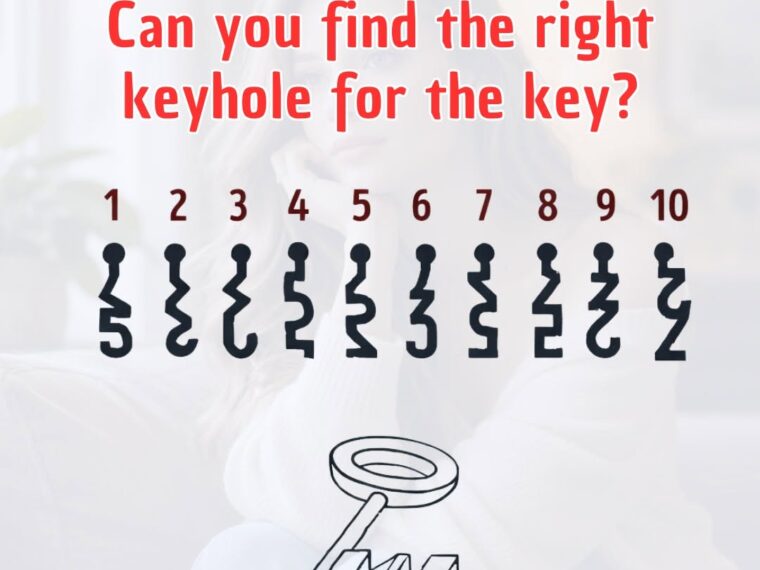
At first glance, it seems like an easy challenge.
You’re shown a single key and ten different keyholes. Your mission is simple: determine which keyhole the key fits.
Most people confidently choose an answer within a few seconds—only to discover they overlooked a tiny detail that changes everything.
That’s exactly why this type of visual puzzle has become so popular online. It combines logic, observation, and patience in a way that encourages people to compare answers, debate their reasoning, and take a second (or third!) look.
Unlike many viral “personality tests,” this puzzle has a logical solution. Success depends not on intuition but on carefully comparing shapes and noticing subtle differences.
Let’s explore how these puzzles work and the best strategy for solving them.
Why This Puzzle Is Harder Than It Looks
Our brains naturally try to recognize patterns as quickly as possible.
Instead of carefully analyzing every detail, we often rely on first impressions.
This mental shortcut helps us make rapid decisions in everyday life, but it can also lead us to overlook important differences.
Visual puzzles take advantage of this tendency by presenting several options that appear nearly identical at first glance.
Only careful observation reveals the correct answer.
What You’re Actually Looking For
The goal isn’t simply to find a keyhole that “looks similar.”
Instead, you’re trying to determine whether the key could physically pass through the opening.
Think of it like matching two puzzle pieces.
Every curve, notch, and edge must align correctly.
Even one small mismatch makes a keyhole impossible.
A Step-by-Step Strategy
Rather than guessing, work through the puzzle systematically.
1. Study the Key First
Before looking at the keyholes, examine the key itself.
Notice:
- Overall shape
- Width
- Length
- Curves
- Notches
- Bulges
- Narrow sections
Understanding the key makes comparisons much easier.
2. Compare One Keyhole at a Time
Avoid jumping randomly between options.
Instead, inspect each keyhole individually.
Ask yourself:
- Is the opening wide enough?
- Do the curves match?
- Are the narrow sections in the correct places?
- Could the key slide through without obstruction?
Eliminate impossible choices immediately.
Pay Attention to Tiny Details
Many wrong answers differ from the correct one by only one small feature.
Common differences include:
- A slightly wider curve
- An extra notch
- A missing indentation
- Different spacing
- Uneven symmetry
These tiny variations are intentional.
Think About Movement
Imagine inserting the key into the lock.
Would every part fit through the opening?
Next page