
The natural world has an incredible way of fooling us.
Sometimes, an animal doesn’t need to become invisible to avoid predators. It simply needs to look like something else.
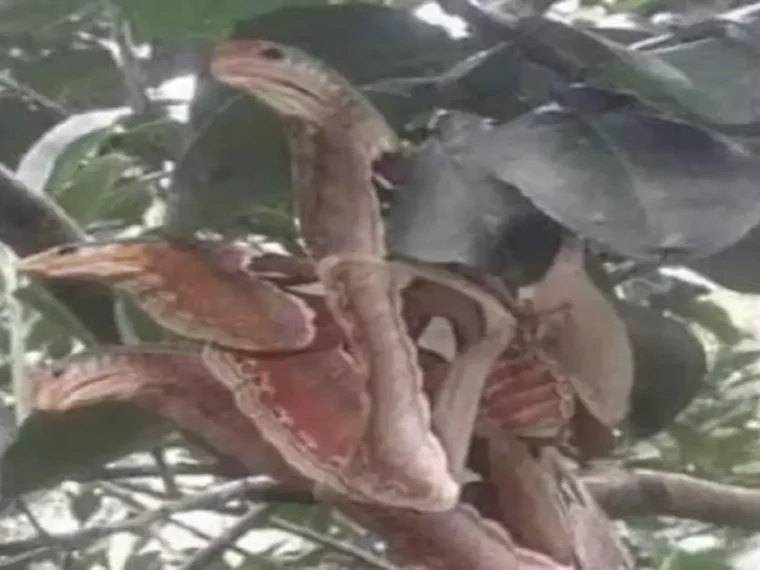
That’s exactly what happened when photographs began circulating online showing what appeared to be several angry snakes hiding among the branches of a tree.
At first glance, the images are genuinely unsettling.
There appear to be multiple snake-like heads peering from the vegetation, complete with patterns that resemble scales and faces that seem almost threatening.
But there is a twist.
Those aren’t snakes at all.
They’re parts of the wings of one of the world’s most spectacular insects: the Atlas moth.
And once you know what you’re looking at, the photographs become even more fascinating.
The Mysterious “Snakes” in the Tree
The photographs attracted attention because the illusion is surprisingly convincing.
The shapes seem to have eyes, mouths, and the unmistakable appearance of a snake’s head.
For anyone who isn’t familiar with the Atlas moth, it would be perfectly understandable to assume that several snakes were resting in the branches.
The illusion becomes particularly effective when the moth’s wings are positioned in a way that exposes the snake-like patterns along their upper edges.
What looks like several reptiles is actually an example of one of nature’s most creative defensive adaptations.
Meet the Atlas Moth
The Atlas moth, scientifically known as Attacus atlas, is a giant moth native to tropical and subtropical regions of Asia.
It is famous for its enormous wings and distinctive patterns.
With a wingspan that can approach 24 centimeters (about 9.5 inches), it is among the largest moths in the world.
Its wings aren’t simply large.
They’re also beautifully patterned, with earthy shades of brown, reddish tones, cream, and other colors that help the moth blend into its surroundings.
But the most remarkable feature may be the markings near the tips of the forewings.
Those markings can resemble the head of a snake.
And that resemblance isn’t accidental.
Why Does an Atlas Moth Look Like a Snake?
The answer is survival.
Adult Atlas moths don’t have many defenses available to them.
They don’t have a dangerous bite.
They don’t have a venomous sting.
And they aren’t particularly powerful flyers.
Instead, they rely heavily on camouflage and deception.
A potential predator that encounters what appears to be a snake may hesitate.
That hesitation could give the moth enough time to escape.
This is an example of mimicry, where one organism resembles another organism or object in a way that provides a survival advantage.
In the Atlas moth’s case, looking like a snake can make a harmless insect appear considerably more intimidating.
The Illusion Becomes Even Better When the Moth Is Threatened
The Atlas moth doesn’t simply sit still and hope predators don’t notice it.
When disturbed, it can actively enhance the illusion.
One defensive behavior involves spreading and moving its wings so that the snake-like markings become much more noticeable.
The moth may also drop toward the ground and move its wings in a way that makes the markings appear even more like a snake’s head.
To a predator approaching quickly, the sudden movement can be startling.
Instead of seeing a large but vulnerable moth, the predator may suddenly perceive what looks like a much more dangerous animal.
It Doesn’t Actually Have a Snake’s Face
Once you know the trick, it’s easier to see what’s happening.
The apparent “eyes” are simply patterns on the wings.
The supposed mouth is also part of the wing pattern.
There is no snake hiding inside the moth.
This is an important distinction because photographs can make the illusion look much more convincing than it does when you know what you’re seeing.
Nature has essentially created a visual trick.
The predator sees one thing.
The moth is something completely different.
Why Do So Many People Fall for It?
Human brains are extremely good at recognizing familiar patterns.
This tendency is called pareidolia—the perception of recognizable shapes, especially faces, in random or ambiguous patterns.
It’s the same reason people sometimes see faces in clouds, tree bark, rocks, or the front of a car.
The Atlas moth takes advantage of a similar visual phenomenon, although its wing patterns are also genuine adaptations that resemble a snake.
When several parts of the wings are visible between branches, the brain can quickly interpret the shapes as multiple animals.
That makes photographs of Atlas moths particularly effective at creating confusion.
The Atlas Moth Is Huge
Even without its incredible camouflage, the Atlas moth is impressive simply because of its size.
Its wings can measure more than 20 centimeters across, making it considerably larger than the average moth people encounter around their homes.
The large wings serve an important purpose during its short adult life, but they also make the moth vulnerable.
Large doesn’t necessarily mean powerful.
In fact, Atlas moths are relatively delicate compared with many other animals.
Their impressive size is one of the reasons their snake-like defensive display is so useful.
Adult Atlas Moths Have a Very Short Life
Here’s another surprising fact.
Adult Atlas moths live for only a relatively short period, often around one to two weeks.
That’s because they emerge from the pupal stage with a very specific mission.
Their adult lives are largely focused on reproduction.
Unlike many animals that spend years growing and reproducing, the Atlas moth’s adult stage is extremely brief.
This short lifespan also explains an unusual feature of the species.
They Don’t Eat as Adults
Once an Atlas moth becomes an adult, its mouthparts are greatly reduced and it does not feed in the way a typical butterfly or moth does.
Instead, it relies on energy reserves accumulated during its larval stage.
That means the caterpillar phase is crucial.
The caterpillar spends its time eating and growing, storing the resources that will eventually support the adult moth.
Once the adult emerges, there is very little time to waste.
It needs to find a mate, reproduce, and continue the life cycle.
The Caterpillar Is Completely Different
Before becoming an enormous moth that looks like a snake, the Atlas moth begins life as a caterpillar.
The caterpillar goes through several stages of growth and consumes large amounts of plant material.
As it grows, it eventually forms a cocoon.
Inside that protective structure, an extraordinary transformation takes place.
The caterpillar’s body is reorganized as it develops into an adult moth.
When the transformation is complete, the adult emerges with its enormous wings.
It may be difficult to believe that the strange caterpillar and the giant snake-mimicking moth are the same species.
Where Do Atlas Moths Live?
Atlas moths are native to parts of South and Southeast Asia, including regions with tropical and subtropical forests.
They are associated with wooded habitats where their large wings and earthy coloration can help them blend into vegetation.
Their natural range includes countries such as India, China, Indonesia, Malaysia, and other parts of Asia.
Because they are tropical insects, their survival depends on suitable temperatures and host plants.
Are Atlas Moths Dangerous?
No.
Despite the snake-like appearance, Atlas moths are not venomous snakes—or dangerous reptiles of any kind.
They aren’t considered a threat to humans.
The intimidating markings exist primarily as a defensive strategy against predators.
If you encounter one, there is no reason to panic.
In fact, the best response is to admire it without disturbing it.
Handling large moths can damage their delicate wings, and unnecessary disturbance can cause them to waste precious energy.
Why Would a Moth Need to Pretend to Be a Snake?
At first, it seems like a strange strategy.
After all, why would a moth evolve to look like a snake?
Because predators don’t always know exactly what they’re looking at.
A bird searching for insects might be willing to attack a moth.
A bird confronted with something resembling a snake may hesitate.
That moment of hesitation can be enough for the moth to escape.
Natural selection favors traits that improve survival and reproduction, even if those traits seem bizarre to us.
Over countless generations, small differences in wing patterns and behavior can become increasingly specialized.
The result is an insect that can produce one of nature’s most convincing visual tricks.
This Is More Than Just Camouflage
There’s an important difference between camouflage and mimicry.
Camouflage helps an animal blend into its surroundings.
Mimicry involves resembling something else.
The Atlas moth does a little of both.
Its overall brown coloration can help it blend into tree bark and leaves.
At the same time, the distinctive wing markings can resemble the head of a snake.
So the moth can effectively use two different strategies depending on the situation:
Stay hidden when possible. Look threatening when necessary.
That’s an incredibly efficient survival strategy for a relatively defenseless insect.
Why the Viral Photographs Are So Fascinating
Photographs of Atlas moths regularly attract attention online because they challenge our expectations.
We think we’re looking at snakes.
Then someone explains that we’re actually looking at moth wings.
Suddenly, the entire image changes.
Instead of seeing a group of threatening reptiles, you start noticing the intricate structure of the wings and the remarkable patterns that evolved to protect the moth.
It’s one of those moments when learning a little more about nature makes something that looked frightening become genuinely beautiful.
Not Every “Snake Moth” Photograph Shows Multiple Moths
Another reason these photographs can be confusing is that a single Atlas moth can create the impression of more than one animal.
Depending on how its wings are positioned, the two forewings can produce multiple snake-like shapes.
When the moth is resting among branches, leaves, or bark, the separate patterns can appear to be several creatures hiding together.
The perspective of a photograph can make the effect even stronger.
That’s why it’s important not to assume that every viral photograph showing multiple snake-like shapes represents multiple snakes—or even multiple moths.
Nature Is Full of Similar Tricks
The Atlas moth isn’t the only animal that uses deception to survive.
Stick insects resemble branches.
Leaf insects resemble foliage.
Some butterflies have markings that resemble eyes.
Certain caterpillars can inflate or move their bodies to imitate snakes or other dangerous creatures.
Even some harmless snakes have evolved appearances that resemble venomous species.
Across the natural world, survival often depends on what a predator thinks it sees.
The Atlas moth simply happens to be one of the most spectacular examples.
The Bottom Line
Those terrifying-looking “snakes” hiding in the tree aren’t necessarily snakes at all.
They may be the wings of an Atlas moth, one of the largest and most visually impressive moths in the world.
Its snake-like wing markings are part of a defensive strategy that can make a harmless insect appear much more dangerous than it really is.
When threatened, the moth can expose and move those markings in a way that reinforces the illusion, potentially causing a predator to hesitate long enough for the moth to escape.
It’s a perfect reminder that nature doesn’t always protect its most vulnerable creatures with claws, venom, or strength.
Sometimes, survival comes down to convincing your enemy that you’re something you aren’t.
And in the case of the Atlas moth, the trick is so convincing that even humans can take a second look and wonder:
“Wait… those aren’t snakes?”