
I’ll be the first to admit that I am terrified of bugs. Spiders and other creepy crawlies have just never been my thing. However, there are a few exceptions I’ll make when it comes to insects—bumblebees, butterflies, and now, the flower mantis.
If you’ve never heard of a flower mantis before, you’re certainly not alone. These remarkable insects are masters of camouflage, and their unusual appearance can make them look more like something from a fantasy movie than a creature you might actually encounter in a garden.
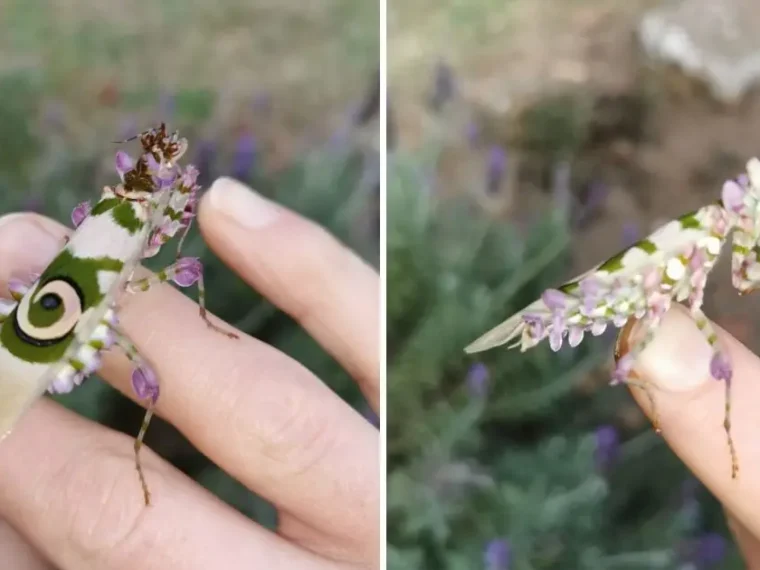
One particularly striking species is the spiny flower mantis, scientifically known as Pseudocreobotra wahlbergi.
This beautiful insect was photographed in Nkutu Valley in KwaZulu-Natal, South Africa. The photographs quickly attracted attention because of the mantis’s extraordinary coloring and flower-like appearance.
And once you see one, it’s easy to understand why people are fascinated by them.
Meet the Spiny Flower Mantis
The spiny flower mantis is a species of praying mantis native to parts of eastern and southern Africa.
Unlike many insects that rely on camouflage to blend into bark, leaves, or soil, this mantis has evolved an entirely different strategy.
It resembles a flower.
Its body can display shades of green, white, pink, and yellow, while its wings feature intricate patterns that make the insect remarkably difficult to distinguish from surrounding vegetation.
The effect is especially impressive when the mantis remains completely still.
From a distance, you might mistake it for part of the flower itself.
And that’s exactly the point.
A Master of Disguise
Camouflage is one of nature’s most fascinating survival strategies.
Animals don’t always need to run faster or fight harder to survive. Sometimes, the best strategy is simply to become difficult to see.
The spiny flower mantis uses its appearance to blend into vegetation and wait for unsuspecting prey to come close.
Its coloration can make it surprisingly difficult for predators to recognize it as an insect.
At the same time, the camouflage provides an advantage when the mantis is hunting.
Instead of chasing prey across open ground, it can remain concealed among flowers and vegetation until a suitable insect comes within striking distance.
It’s essentially an ambush predator disguised as part of the garden.
Why Does It Look Like a Flower?
The answer comes down to survival.
The mantis spends much of its time associated with vegetation, particularly flowering plants. Looking like a flower can make it less noticeable to both predators and potential prey.
This is a form of crypsis, where an animal’s appearance helps reduce the likelihood that it will be detected.
The resemblance isn’t necessarily perfect from every angle.
But insects don’t always see the world the same way humans do, and even a rough resemblance can be useful when an animal remains still among similar colors and shapes.
The mantis’s unusual appearance is therefore not simply decorative.
It is part of its survival strategy.
Those Strange Markings Have a Purpose
One of the most eye-catching features of the spiny flower mantis is the dramatic pattern on its wings.
When the wings are folded, the insect can look remarkably inconspicuous.
But when threatened, the mantis can spread its wings and reveal much more striking patterns.
This sudden transformation can surprise a potential predator.
The behavior is known as a deimatic display, a defensive strategy in which an otherwise concealed animal suddenly exposes conspicuous markings to startle or discourage a predator.
The effect can be startling.
An insect that appeared to be a harmless piece of vegetation suddenly looks much larger and more conspicuous.
It’s another example of how the mantis has multiple strategies for avoiding danger.
Those “Spines” Aren’t Just for Decoration
The common name “spiny flower mantis” comes from the distinctive spiny structures on its body and legs.
These features contribute to its unusual appearance and help make its silhouette resemble vegetation.
Like other praying mantises, the species also has specialized raptorial forelegs.
These front legs are adapted for grabbing prey.
They are lined with spines that help the mantis hold onto insects once it has captured them.
For an unsuspecting insect, getting caught by those front legs can be almost impossible to escape.
What Does the Flower Mantis Eat?
Despite its delicate appearance, the spiny flower mantis is an effective predator.
It primarily hunts other insects.
Depending on its size and opportunity, it may capture flying insects and other small arthropods.
The mantis often waits patiently rather than actively searching for prey.
This hunting method makes sense for an animal whose greatest advantage is camouflage.
Why waste energy chasing insects when you can simply wait for one to come close?
Once prey enters range, the mantis can strike extremely quickly using its specialized front legs.
Does It Really Eat Bees?
Bees can be among the insects targeted by flower mantises.
That makes the relationship between the mantis and flowering plants particularly interesting.
The same flowers that attract pollinating insects can also provide hunting opportunities for predators.
A bee approaches a flower looking for nectar or pollen.
The mantis is already there.
From the bee’s perspective, the flower may appear perfectly ordinary.
The mantis, meanwhile, is waiting for an opportunity.
This is an example of the complicated food webs that exist in gardens and natural habitats.
A flowering plant can simultaneously provide food for pollinators and a hunting ground for predators.
Why Was the Mantis Found on Flowers?
Finding this species among flowers isn’t surprising.
Flowering plants provide both camouflage and access to potential prey.
The mantis can position itself where insects are naturally likely to appear.
This strategy is particularly effective because many pollinating insects focus on finding food rather than looking for predators hiding among the petals.
For the mantis, a flower can therefore function as both a hiding place and a hunting platform.
What Happens When It Feels Threatened?
The spiny flower mantis doesn’t always rely on camouflage when danger approaches.
If its disguise fails, it can switch to a defensive display.
The mantis may raise its wings and expose colorful markings, making itself appear much more conspicuous.
This sudden change can startle predators that expected to see a small, motionless insect.
Some mantises can also sway their bodies or adopt defensive postures.
The goal isn’t necessarily to attack.
It’s often to make the predator hesitate long enough for the mantis to escape.
Is the Spiny Flower Mantis Dangerous to Humans?
No.
Like other mantises, the spiny flower mantis is not considered dangerous to people.
It is a predator, but its prey consists primarily of small animals and insects.
If you encounter one, there’s no reason to panic.
In fact, the best thing you can do is observe it without disturbing it.
These insects are fascinating examples of adaptation, and handling them unnecessarily can cause stress or injury.
A Remarkable Example of Sexual Dimorphism
Male and female spiny flower mantises can differ noticeably in size and appearance.
As in many mantis species, females are generally larger than males.
The difference can be particularly noticeable once you understand what you’re looking at.
Female mantises also have to accommodate the production of eggs, which means their abdomen can become noticeably larger during reproduction.
This may explain why some photographs of female spiny flower mantises make them appear particularly broad-bodied.
However, determining whether a specific individual is pregnant or carrying eggs from a photograph alone isn’t always possible.
How Do They Reproduce?
Like other praying mantises, spiny flower mantises reproduce through sexual reproduction.
After mating, the female eventually produces an ootheca, a protective egg case containing multiple eggs.
The egg case provides protection while the developing young mature.
Eventually, tiny young mantises emerge and begin life independently.
Unlike mammals, mantises don’t raise their offspring.
The young must immediately begin finding food and avoiding predators on their own.
Baby Mantises Look Surprisingly Different
Young mantises, known as nymphs, generally don’t look exactly like miniature adults.
They lack fully developed wings and go through a series of molts as they grow.
Each molt allows the insect to increase in size and gradually develop the characteristics of the adult.
Because mantises have an exoskeleton rather than an internal skeleton, they cannot simply grow continuously inside their existing outer body.
They have to shed the old exoskeleton and produce a larger one.
This makes molting a particularly vulnerable period.
Why Mantis Species Are So Fascinating
The spiny flower mantis is just one example of the extraordinary diversity found among praying mantises.
Different mantis species have evolved different forms of camouflage.
Some resemble leaves.
Others resemble sticks, bark, moss, or flowers.
Their bodies demonstrate how natural selection can produce remarkably specialized forms over long periods.
The result can sometimes look almost too strange to be real.
But that’s what makes encounters like this so memorable.
A Reminder That “Bugs” Aren’t All the Same
For someone who is normally terrified of insects, a flower mantis can be a useful reminder that the word “bug” covers an enormous variety of animals.
Some insects are pests.
Others pollinate plants.
Some recycle nutrients.
Others control populations of other insects by acting as predators.
And some are simply astonishingly beautiful.
The spiny flower mantis happens to combine several of these fascinating characteristics into one tiny animal.
It’s a predator.
It’s camouflage.
It’s a master of disguise.
And, when threatened, it can suddenly transform its appearance with a dramatic wing display.
Should You Leave One Alone If You Find It?
Absolutely.
If you happen to discover a flower mantis in your garden, the best response is to observe it rather than capture it.
Avoid spraying it with pesticides or disturbing the plant unnecessarily.
Take photographs from a safe distance if you want to document the encounter.
If you’re gardening in an area where native mantis species occur, maintaining diverse flowering plants and avoiding unnecessary pesticide use can help support a wider variety of insects.
A garden isn’t just a collection of decorative plants.
It’s a miniature ecosystem.
And creatures like the spiny flower mantis are part of that ecosystem.
The Bottom Line
The next time you see something that looks suspiciously like a flower but seems to have legs, don’t immediately assume you’re imagining things.
You may have discovered a flower mantis.
The spiny flower mantis (Pseudocreobotra wahlbergi) is a remarkable African mantis known for its flower-like appearance, striking wing patterns, and highly specialized camouflage.
Its unusual appearance isn’t the result of human editing or some fantasy creature brought to life.
It’s the result of evolution.
The mantis has developed a body that helps it disappear among flowers, wait patiently for prey, and surprise predators when its disguise is discovered.
And perhaps that’s the most amazing part.
Nature doesn’t always need bright colors or enormous size to create something spectacular.
Sometimes, it creates a tiny predator that looks like a flower—and that’s enough to make anyone stop and stare.