
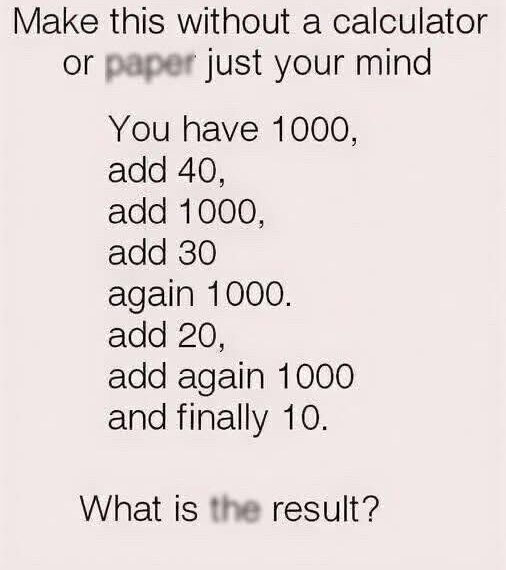


Every day, social media is flooded with posts that say things like:
- “Only geniuses can solve this.”
- “Test your math skills.”
- “Most people get this wrong.”
- “The answer is in the first comment.”
At first glance, these puzzles often look simple. They resemble elementary-school arithmetic and seem easy enough to solve in a few seconds.
Yet thousands of people end up debating different answers.
Why?
Usually, the challenge isn’t the mathematics itself—it’s the temptation to answer too quickly.
The Real Trap: Rushing
Most viral math puzzles are designed to encourage fast responses.
People often:
- Glance at the equation
- Assume they know the answer
- Skip careful calculation
- Ignore mathematical rules
The result is predictable: many arrive at the wrong answer despite knowing the correct principles.
Order of Operations Matters
The most common source of mistakes is forgetting the order of operations.
In mathematics, calculations are generally performed in this sequence:
1. Parentheses
Calculate anything inside parentheses first.
2. Exponents
Handle powers and roots.
3. Multiplication and Division
Work from left to right.
4. Addition and Subtraction
Work from left to right.
Many viral puzzles are specifically designed to exploit confusion about these rules.
Example
Consider:
8 + 2 × 5
Some people answer:
50
because they add first:
(8 + 2) × 5 = 50
However, according to the standard order of operations:
2 × 5 = 10
then:
8 + 10 = 18
The correct answer is 18.
Why These Puzzles Spread So Quickly
Social media algorithms favor content that generates engagement.
A puzzle that produces multiple answers creates:
Next page