Common mallow is a small plant that many people simply consider a weed growing naturally in gardens, meadows, roadsides, and cultivated fields. Yet behind its rounded leaves and delicate flowers lies a plant with a long history of culinary and medicinal use.
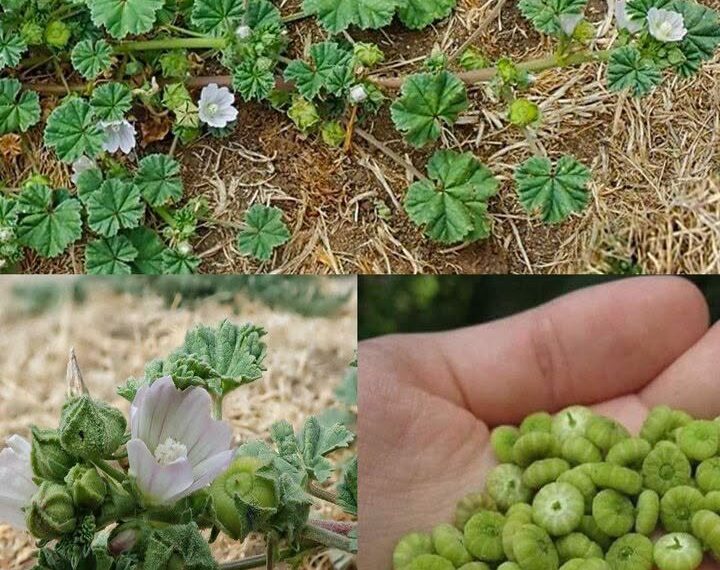
The image associated with this article appears to show a mallow belonging to the Malva genus, recognizable by its rounded leaves, creeping stems, pale pinkish-white flowers, and distinctive disk-shaped fruits. However, identifying a plant solely from a photograph can be uncertain. Its appearance is consistent with species such as Malva neglecta, commonly known as common mallow or dwarf mallow in some regions.
Mallow attracts scientific interest because of its richness in mucilage, flavonoids, polyphenols, and other plant compounds. Studies have investigated its antioxidant, anti-inflammatory, antimicrobial, and wound-healing properties.
However, a distinction must be made:
Properties observed in laboratory studies or plant extracts do not automatically mean that consuming mallow can treat diseases in humans.
Here’s what current research and traditional knowledge tell us about this remarkable plant.
What Is Common Mallow?
Mallow belongs to the Malvaceae family, the same botanical family as:
- Okra
- Cotton
- Marshmallow plant (Althaea officinalis)
Several species of the Malva genus grow naturally in Europe, North Africa, Asia, and many other regions of the world.
Among the most common species are:
- Malva neglecta
- Malva sylvestris (common mallow)
- Malva parviflora (small-flowered mallow)
- Other regional species within the Malva genus
Traditionally, various parts of the plant, including the leaves, flowers, and seeds, have been used as food and herbal remedies.
1. A Plant Rich in Mucilage
One of the most interesting features of mallow is its high content of mucilage.
Mucilage consists mainly of plant polysaccharides that absorb and retain water, creating a soft, gel-like texture.
This characteristic helps explain why mallow has traditionally been used to soothe irritated tissues, particularly:
- The throat
- The digestive tract
- The skin
The leaves and flowers are especially rich in these compounds.
2. Traditionally Used to Soothe the Throat
For centuries, mallow has been used in herbal preparations intended to ease minor throat irritation.
The mucilage can form a protective coating over mucous membranes, which may help reduce discomfort caused by:
- Dryness
- Mild irritation
- Occasional coughing
Leaves and flowers are commonly prepared as herbal infusions.
However, it is important to note that such traditional uses should not be presented as medical treatments for respiratory infections or other illnesses.
3. Contains Antioxidant Compounds
Mallow contains numerous compounds belonging to the polyphenol family.
These include:
- Flavonoids
- Anthocyanins
- Phenolic compounds
- Tannins
- Carotenoids
- Vitamins C and E in certain plant parts
Laboratory studies have identified antioxidant activity in various mallow extracts.
Antioxidants are of interest because they may help neutralize certain free radicals involved in oxidative processes.
Nevertheless:
Antioxidant activity observed in laboratory tests does not necessarily translate into identical effects within the human body after consumption.
4. An Interesting Anti-Inflammatory Potential
Researchers have also explored the plant’s potential anti-inflammatory properties.
Experimental studies on Malva sylvestris extracts have demonstrated biological activities that may help explain some of the plant’s traditional uses.
Scientists are particularly interested in:
- Flavonoids
- Polyphenols
- Mucilage compounds
These findings may help explain why mallow has historically been used to soothe mild skin and mucosal irritations.
However, the available evidence does not support replacing medical treatment with mallow for inflammatory diseases.
5. Potential Benefits for Digestive Comfort
Mallow has a long history of traditional use for digestive well-being.
Herbal preparations have traditionally been used for:
- Mild digestive irritation
- Occasional constipation
- Minor abdominal discomfort
- General intestinal comfort
Its mucilage and fiber content are especially relevant in this context.
Dietary fiber may help:
- Increase stool bulk
- Retain water within the digestive tract
- Support normal bowel function
That said, mallow should not be viewed as a powerful laxative or as a treatment for chronic digestive disorders.
6. A Natural Source of Fiber
In some cultures, mallow is consumed as a vegetable.
Young leaves may be added to:
- Soups
- Stews
- Salads
- Omelets
- Vegetable dishes
When cooked, the leaves develop a slightly mucilaginous texture similar to that of okra.
This culinary use provides:
- Fiber
- Various micronutrients
- Bioactive plant compounds
7. Being Studied for Wound-Healing Properties
One of the most promising areas of research involving mallow concerns skin healing.
Studies on Malva neglecta have identified phenolic compounds and observed activities that may support wound-healing processes in experimental settings.
These observations help explain why researchers continue investigating mallow in the fields of:
- Herbal medicine
- Dermatology
- Natural skincare products
However:
Fresh plant material should not be applied directly to open wounds without proper medical guidance.
8. Traditionally Used for Skin Care
Mallow is also valued for its emollient properties.
An emollient is a substance that helps:
- Soften the skin
- Protect the skin barrier
- Improve skin comfort
Traditionally, mallow leaves and preparations have been used to soothe:
- Minor skin irritation
- Inflammation
- Dryness
- Surface discomfort
The plant’s mucilage likely contributes to these effects by creating a protective layer on the skin.
9. A Long History of Traditional Medicine
The medicinal use of mallow is far from new.
Plants rich in mucilage, including Malva sylvestris, have appeared in various traditional medical systems for centuries.
Historical records describe their use in preparations intended to support:
- Respiratory health
- Digestive comfort
- Urinary health
- Skin care
Ethnobotanical surveys conducted in different regions continue to document the traditional use of species such as Malva neglecta.
While this history is fascinating, traditional use alone should not be considered proof of clinical effectiveness.
10. What Do the Leaves and Flowers Actually Contain?
The chemical composition of mallow is particularly rich and diverse.
Researchers have identified several groups of compounds, including:
Flavonoids
Plant compounds studied for their antioxidant and anti-inflammatory properties.
Mucilage
One of the defining characteristics of the Malvaceae family, known for its soothing and protective effects on mucous membranes.
Polyphenols
Widely studied for their antioxidant activity.
Anthocyanins
Natural pigments responsible for some flower colors and investigated for their antioxidant properties.
Tannins
Plant compounds with various biological activities found in multiple parts of the plant.
Phytochemical analyses of Malva sylvestris have confirmed the presence of many of these substances.
What About the Small Green Fruits?
The small green disk-shaped fruits visible on mallow plants are sometimes referred to as “cheeses” because of their shape.
These fruits contain seeds and have traditionally been used in some regions as:
- A food source
- A herbal preparation ingredient
- A component of traditional remedies
Like the rest of the plant, they contain various naturally occurring compounds that continue to attract scientific interest.
Key Takeaways
✅ Common mallow is a plant with a long history of culinary and traditional medicinal use.
✅ It is rich in mucilage, flavonoids, polyphenols, and other bioactive compounds.
✅ Research has explored its antioxidant, anti-inflammatory, soothing, and wound-healing potential.
✅ Traditional uses include supporting throat comfort, digestion, and skin care.
✅ More high-quality human studies are needed before firm medical conclusions can be drawn.
What About You?
🌿 Option 1: I already knew about the traditional uses of mallow.
🌿 Option 2: I’m surprised that this common plant has so many interesting properties.
🌿 Option 3: I’d like to learn more about medicinal and edible wild plants.
Share your thoughts in the comments and tell us if you’ve ever come across common mallow in your garden! 🌸🌿✨