Brain teasers have become incredibly popular on social media because they challenge our observation skills and encourage us to think differently. Some puzzles test logic, while others rely on visual perception or mathematical reasoning.
One of the most widely shared examples asks a simple question:
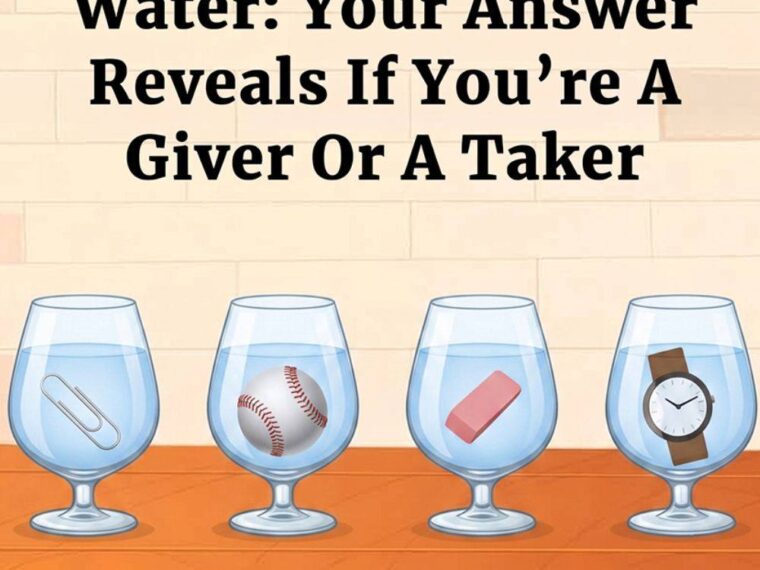
Which glass contains the most water?
At first glance, the answer may seem obvious—but appearances can be deceptive. The puzzle also often includes personality interpretations, suggesting your choice reveals whether you’re a “giver” or a “taker.”
But how accurate are these claims?
Let’s explore both the science behind the puzzle and the psychology that makes these personality quizzes so entertaining.
The Puzzle
Imagine four identical glasses.
Each glass is filled to approximately the same visible water level, but each contains a different object:
- Glass A: A paperclip
- Glass B: A baseball
- Glass C: An eraser
- Glass D: A wristwatch
Your challenge is simple:
Which glass actually contains the most water?
Many people immediately focus on how full each glass appears, but there’s one important scientific principle that determines the correct answer.
The Key Concept: Water Displacement
The answer depends on displacement.
Whenever an object is placed into water, it pushes aside—or displaces—an amount of water equal to the volume of the submerged portion of that object.
This means:
- Larger objects take up more space.
- Smaller objects take up less space.
- Less space occupied by the object means more room remains for water.
Even though the water level appears similar in every glass, the amount of actual water inside each one is different.
The Correct Answer
The correct answer is Glass A, the one containing the paperclip.
Here’s why:
The paperclip occupies only a very small volume.
Because it displaces the least amount of water, that glass can contain more water than the others.
By comparison:
- The baseball occupies the greatest volume.
- The wristwatch takes up considerably more space than a paperclip.
- The eraser also displaces more water than the paperclip.
Therefore, the glass with the smallest object holds the greatest amount of water.
Why This Puzzle Tricks So Many People
Our brains naturally rely on visual shortcuts.
When we quickly compare the glasses, we often notice:
- The height of the water.
- The size of the object.
- The overall appearance.
Instead of calculating volume, we instinctively judge what we see.
This mental shortcut is useful in everyday life but can lead us to incorrect conclusions in puzzles like this.
Understanding Water Displacement
Water displacement is an important scientific principle taught in schools around the world.
It explains many everyday observations.
For example:
- A person entering a swimming pool causes the water level to rise.
- Large ships float because they displace enormous amounts of water.
- Ice cubes increase the liquid level in a drink.
- Measuring displacement can help estimate the volume of irregularly shaped objects.
This concept dates back more than 2,000 years and is famously associated with the ancient Greek scientist Archimedes.
What Does Your Choice Say About You?
Many versions of this puzzle include personality descriptions based on the glass you selected.
It’s important to remember that these interpretations are for entertainment only.
There is no scientific evidence that choosing a particular glass can determine whether someone is a giver, taker, leader, or any other personality type.
However, the descriptions can still be fun prompts for self-reflection.
If You Chose Glass A
You may enjoy solving problems logically.
You might appreciate:
Next page