
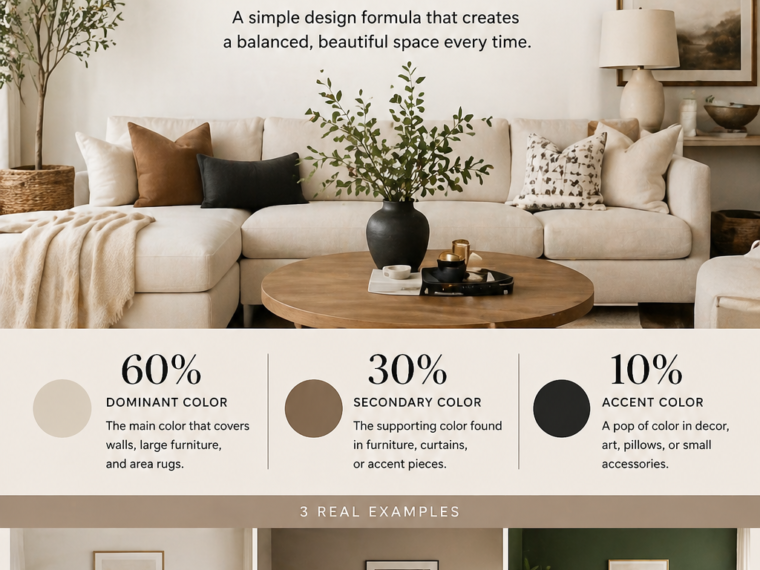
How to use the 60–30–10 rule to create a balanced, beautiful space
Why Color Feels So Difficult (But Doesn’t Have to Be)


6
Choosing colors for your living room can feel overwhelming. You might love beige, green, black, and wood tones—but when you try to combine them, something feels “off.” The space can quickly look messy, flat, or visually heavy.
This usually happens because there’s no clear structure behind the colors. Instead of working together, each color competes for attention.
That’s where the 60–30–10 rule comes in. It’s one of the simplest and most effective ways to create a living room that feels balanced, cohesive, and professionally designed—without needing any advanced design skills.
What Is the 60–30–10 Rule?


6
The rule is straightforward:
- 60% = Main color (dominant)
- 30% = Secondary color
- 10% = Accent color
These percentages don’t need to be exact measurements. Think of them as a visual balance rather than a strict calculation.
Here’s how it works in practice:
- The 60% color fills most of the room (walls, large furniture)
- The 30% color supports it (rugs, curtains, chairs)
- The 10% color adds personality (pillows, decor, art)
This structure ensures that your space feels organized and intentional instead of random.
Step 1: Choose Your 60% (The Foundation)


6
Your dominant color sets the tone of the entire room. It’s what people notice first and what ties everything together.
Most of the time, this color is:
- On your walls
- Your sofa
- Or both
Popular choices include:
- Soft white
- Beige or cream
- Light gray
- Warm taupe
Why neutrals work best here:
- They make the room feel bigger and calmer
- They’re easier to match with other colors
- They don’t overwhelm the space
Example:
A living room with white walls and a beige sofa already covers most of the 60%.
Step 2: Add the 30% (Depth and Contrast)


6
The secondary color adds richness and prevents the room from looking flat or boring.
You’ll usually see it in:
- Rugs
- Curtains
- Accent chairs
- Wood finishes
This color should contrast slightly with your main color—but still feel harmonious.
Examples:
- Beige base + warm brown secondary
- White base + soft gray secondary
- Neutral base + muted green secondary
Tip:
If your 60% is very light, your 30% can be slightly darker to create balance.
Step 3: Use the 10% (The Personality Layer)


7
This is where your living room comes to life.
The accent color is used in small touches:
- Throw pillows
- Artwork
- Vases
- Decorative objects
Because it’s only 10%, you can be bold here without overwhelming the space.
Examples:
- Black accents in a neutral room
- Terracotta in a beige setting
- Mustard yellow in a gray space
- Gold or brass details for warmth
This layer adds contrast, interest, and personality.
Real-Life Color Combinations You Can Copy
1. Calm Neutral Living Room


8
- 60%: Beige and cream
- 30%: Warm brown (wood, rug)
- 10%: Black accents
Why it works:
The soft base feels calm, the brown adds warmth, and black creates contrast.
2. Modern Minimalist Look


6
- 60%: White
- 30%: Gray
- 10%: Black
Why it works:
Simple, clean, and timeless. Perfect for a sleek, uncluttered feel.
3. Earthy Cozy Style


8
- 60%: Warm beige
- 30%: Olive green
- 10%: Terracotta
Why it works:
Inspired by nature, this palette feels relaxing and grounded.
4. Soft Elegant Palette


6
- 60%: Soft white
- 30%: Blush pink or taupe
- 10%: Gold accents
Why it works:
Light, airy, and elegant without being overwhelming.
Common Mistakes to Avoid


6
Even with a simple rule, mistakes can happen. Here are the most common ones:
1. Using too many colors
Stick to 2–3 main tones. Too many colors create chaos.
2. Making everything the same color
A fully beige room with no contrast can feel flat and lifeless.
3. Overusing the accent color
If your 10% becomes 30%, it loses its impact.
4. Ignoring undertones
Warm and cool tones don’t always mix well. Try to stay consistent.
How to Apply This in a Small Living Room


6
If your space is small, the rule becomes even more powerful.
- Use light colors for the 60% to make the room feel bigger
- Keep the 30% soft and not too dark
- Use the 10% carefully to avoid visual clutter
Example:
White (60%) + light gray (30%) + soft blue (10%)
This keeps the space open while still adding personality.
A Simple Way to Start Today


6
If you want to apply this without overthinking:
- Look at your current living room
- Identify your dominant color
- Choose one supporting color
- Add 1–2 accent tones through decor
You don’t need to replace everything. Small changes—like pillows, a rug, or art—can completely transform your space.
Final Thought
The 60–30–10 rule works because it gives your living room a clear structure. Instead of guessing, you’re following a balance that designers have used for years.
It’s not about limiting creativity—it’s about guiding it.
Once you understand this formula, decorating becomes easier, faster, and more intentional. And the best part? You can apply it to any style—modern, boho, minimalist, or cozy.
So before you buy anything new, pause and ask:
What are my 60, 30, and 10?