Conversations about food are louder than ever. Social media is packed with viral diet trends, bold nutrition claims, and extreme eating challenges. From carnivore diets to plant-based protocols, people are constantly experimenting with what they eat in hopes of improving weight, energy, longevity, and metabolic health.
But few experiments have been as bold—or as eyebrow-raising—as consuming 700 eggs in one month.
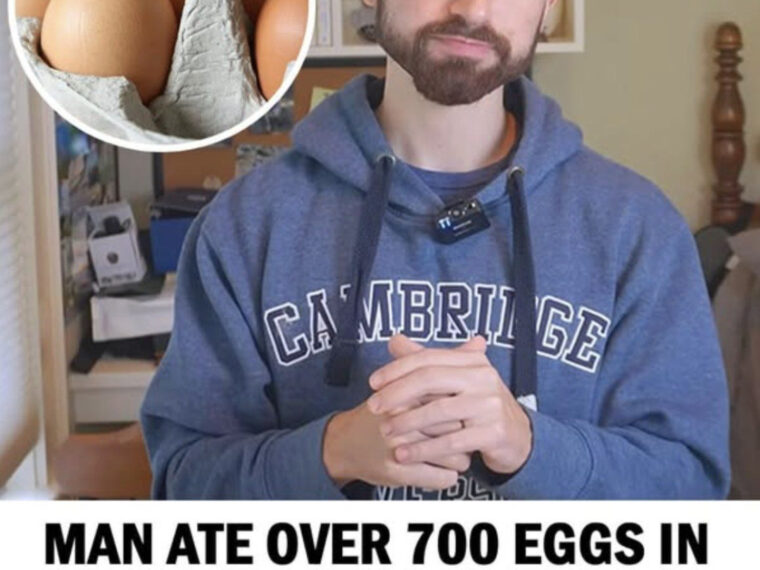
That’s exactly what metabolic health researcher Dr. Nick Norwitz set out to do. Over the course of 30 days, he documented eating roughly 24 eggs per day, or about one egg per hour while awake. His goal? To test a long-debated question in nutrition science:
Does eating large amounts of dietary cholesterol significantly raise LDL (“bad”) cholesterol?
The answer, at least in his case, surprised many.
Why Eggs Have Been So Controversial
For decades, eggs were demonized. Nutrition guidelines once warned that consuming cholesterol-rich foods—like egg yolks—would directly increase blood cholesterol and raise the risk of heart disease.
Eggs contain about 186 milligrams of cholesterol per yolk, which once made them a target of concern. Many people limited themselves to just a few eggs per week out of fear of harming their heart health.
But more recent research has complicated that narrative.
Scientists now understand that the body tightly regulates cholesterol levels. The liver produces cholesterol naturally. When dietary intake rises, the liver often compensates by producing less. When dietary intake drops, the body may produce more.
In other words, dietary cholesterol does not always equal higher blood cholesterol.
Still, eating 700 eggs in a month is far beyond normal consumption—making this experiment a fascinating real-world stress test of that theory.
The Results: What Happened to His Cholesterol?
Dr. Norwitz tracked his blood markers throughout the month.
Here’s what he reported:
- After two weeks: LDL cholesterol dropped by about 2%.
- By the end of the month: LDL cholesterol had declined approximately 18%.
Rather than spiking, his LDL actually decreased.
That result runs counter to decades of dietary fear surrounding eggs.
But there’s more nuance to the story.
The Carbohydrate Twist
During the latter half of the experiment, Dr. Norwitz increased his carbohydrate intake. He added fruits such as:
- Blueberries
- Bananas
- Strawberries
Interestingly, the most significant LDL reductions coincided with this dietary shift.
This detail highlights something critical: nutrition doesn’t operate in isolation.
The body responds to overall dietary patterns—not just single foods.
The interaction between fat, carbohydrates, fiber, and total caloric intake influences cholesterol metabolism in complex ways.
What This Experiment Does (and Doesn’t) Prove
Before anyone rushes to eat two dozen eggs a day, it’s important to understand the limitations.
- It’s a single-subject experiment.
One person’s response cannot be generalized to everyone. - Genetics matter.
Some individuals are “hyper-responders” to dietary cholesterol, while others are not. - Metabolic health varies widely.
Insulin sensitivity, liver function, inflammation levels, and activity patterns all influence cholesterol markers. - Short-term vs. long-term outcomes differ.
A 30-day experiment doesn’t automatically translate to lifetime cardiovascular risk.
What this experiment really illustrates is the complexity of human metabolism.
Nutrition science is rarely black and white.
Why LDL Isn’t the Whole Story
LDL cholesterol is often labeled “bad,” but the reality is more nuanced.
There are different types of LDL particles. Some are small and dense (associated with higher risk), while others are larger and less harmful. Standard cholesterol panels do not always distinguish between these subtypes.
Additionally, inflammation, blood sugar levels, triglycerides, HDL cholesterol, and lifestyle factors all contribute to cardiovascular risk.
A single marker doesn’t tell the full story.
Eggs: Nutritional Powerhouse or Risky Food?
Eggs aren’t just cholesterol delivery systems. They are nutritionally dense foods containing:
- High-quality complete protein
- Choline (important for brain function)
- Vitamin B12
- Vitamin D
- Selenium
- Lutein and zeaxanthin (supporting eye health)
For many healthy individuals, moderate egg consumption is considered safe.
But 24 eggs per day? That’s clearly an extreme.
Dr. Norwitz’s experiment wasn’t meant to promote extreme eating—it was meant to challenge assumptions.
What This Means for You
If there’s one takeaway from the 700-egg experiment, it’s this:
Nutrition is individualized.
Some people can consume higher amounts of dietary cholesterol without adverse effects. Others may see increases in LDL levels.
The key factors that influence response include:
- Genetics
- Overall dietary composition
- Fiber intake
- Physical activity
- Insulin sensitivity
- Existing metabolic conditions
Rather than focusing on single foods as villains or heroes, it’s more helpful to evaluate your entire lifestyle.
And Then, Something Completely Unexpected
While this story began as a bold nutrition experiment, what follows shifts from science to something deeply human.
Because sometimes, the biggest revelations don’t happen in a lab.
They happen in life.
“I Thought I Knew Everything About My Husband”
I believed I knew every chapter of my husband Daniel’s life.
We had been married for 28 years.
Long enough to memorize the rhythm of each other’s habits.
I knew how he stirred his coffee—always counterclockwise.
I knew he hummed off-key when he was nervous.
I knew the stories about his childhood, his college years, and his first apartment with broken heating and secondhand furniture.
We lived simply.
No secret bank accounts.
No mysterious business trips.
No hidden corners of life.
Just Sunday grocery runs.
Morning coffee together.
Quiet evenings watching old detective shows.
We never had children. That was our one silent ache. But we built a life around each other.
Or so I thought.
The Day Everything Changed
Daniel’s death was sudden.
A heart attack in the driveway.
One moment we were arguing about whether the fence needed repainting.
The next, I was in the back of an ambulance holding his hand.
“Daniel, stay with me!” I begged.
But his hand went slack before we reached the hospital.
After 28 years, my world collapsed in minutes.
The Funeral
The funeral was small.
Family. A few coworkers. Neighbors.
I stood there greeting people through a fog of grief.
Then I noticed someone I didn’t recognize.
A teenage boy.
Maybe 15 or 16.
He stood apart from the others, shifting nervously from foot to foot.
Finally, he walked toward me.
“Are you Mrs. Harper?” he asked.
“Yes,” I whispered.
He swallowed.
“My name is Owen,” he said. “I think… I think your husband was my father.”
The Words That Shattered Everything
Time stopped.
My ears rang.
I stared at him, waiting for him to laugh and say it was a mistake.
But he didn’t.
Instead, he pulled out his phone and showed me photos.
Photos of Daniel.
With a younger woman.
Holding a baby.
Owen.
The timestamps went back sixteen years.
Sixteen.
Which meant that for more than half of our marriage, Daniel had been living a parallel life.
Two Truths at Once
Grief is complicated enough.
But betrayal layered over grief is something else entirely.
I didn’t know which emotion to feel first.
Rage.
Shock.
Denial.
Heartbreak.
How could the man who stirred his coffee the same way every morning keep something so enormous hidden?
Yet when I looked at Owen, I didn’t see betrayal.
I saw a scared boy who had just lost his father too.
The Unexpected Choice
We sat down after the funeral.
Owen told me his mother had died three years earlier.
Daniel had been supporting him quietly.
Financially. Emotionally.
Visiting under the guise of “business trips.”
All those times I thought he was traveling for work…
He was seeing his son.
I felt anger rise like a wave.
But beneath it was something else.
Daniel may have lied.
But he had loved this boy.
And now, we were the only two people left who shared that love.
When Life Refuses to Be Simple
Just like the egg experiment challenged assumptions about cholesterol, life challenged my assumptions about my marriage.
I thought I knew everything.
I didn’t.
I thought love meant transparency.
Sometimes, it also means complexity.
Sometimes people are both faithful in devotion and flawed in secrecy.
A New Chapter
It’s been months now.
Owen comes by on Sundays.
We drink coffee.
He stirs his cup counterclockwise.
Just like Daniel.
And sometimes, I don’t know whether to cry or smile.
Because grief doesn’t erase love.
And betrayal doesn’t erase shared humanity.
Final Thoughts
The 700-egg experiment reminds us that the body is more complex than headlines suggest.
And my story reminds me that people are too.
Science evolves.
So do relationships.
And sometimes, what we think we know—about cholesterol or about the people we love—is only part of the picture.
Life, like metabolism, is nuanced.
And the truth is rarely as simple as we want it to be.