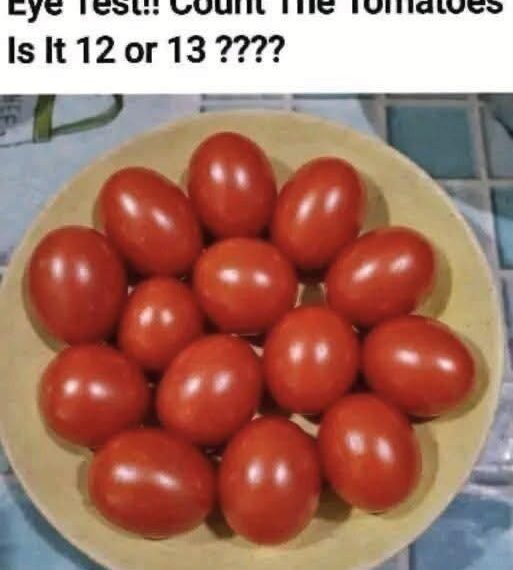
Have you ever looked at a simple picture and suddenly felt unsure of what you were seeing? 🤔 That’s exactly what happens with this viral “count the tomatoes” image. At first glance, the task seems easy and even a bit fun: just count the tomatoes on the plate and decide whether there are 12 or 13. But once you really start focusing, things become surprisingly confusing—and that’s where this puzzle becomes so interesting.
This image has been widely shared across social media, sparking debates, disagreements, and even playful arguments. Some viewers confidently count 12 tomatoes, while others are just as certain there are 13. So what’s really going on here? And why is something so simple suddenly so difficult?
Let’s explore not only the possible answer, but also what this illusion reveals about how your brain processes visual information.
Why This Image Is So Tricky
At its core, this puzzle plays with the way our brains interpret crowded visuals. Normally, counting objects is easy when everything is clearly separated. But in this case, the tomatoes are packed closely together, making it harder to distinguish each one.
1. Overlapping Shapes
Some tomatoes are partially hidden behind others. When objects overlap, your brain has to “fill in the gaps” and guess where one object ends and another begins. This can lead to undercounting—or sometimes even overcounting.
2. Similar Appearance
All the tomatoes have nearly identical color, size, and texture. Because they look so similar, your brain struggles to create clear boundaries between them. Without contrast, distinguishing individual items becomes much harder.
3. Circular Arrangement
The tomatoes are arranged in a circular pattern on a plate. This encourages your brain to group them instead of seeing them individually. You might unconsciously divide them into clusters—like an outer ring and an inner group—which can change how you count them.
The Role of Visual Perception
This puzzle is a perfect example of how human perception works. Your brain is incredibly efficient—it doesn’t analyze every detail separately. Instead, it uses shortcuts (called heuristics) to quickly interpret what you see.
These shortcuts help you in everyday life, but in situations like this, they can create confusion.
Gestalt Principles at Work
Your brain tends to organize objects into patterns. This is known as Gestalt perception. In this image:
- You group nearby tomatoes together
- You assume symmetry or patterns that may not actually exist
- You simplify complex visuals into easier shapes
Because of this, two people can look at the same image and genuinely see different counts.
Lighting and Reflection Effects
Next page