
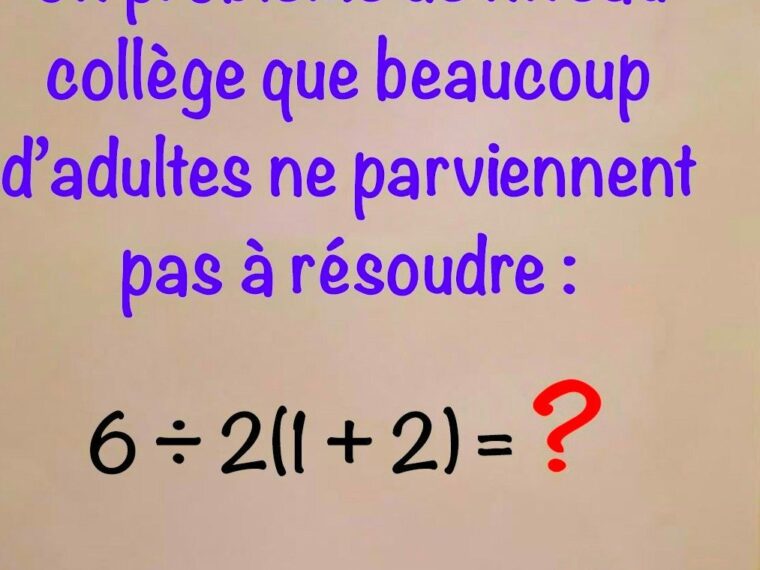
This expression — 6 ÷ 2(1 + 2) — has gone viral many times. It has appeared:
- On Reddit math forums
- In viral Facebook posts
- In YouTube debates
- On Twitter threads with millions of views
- Even in online IQ test “trick questions”
Why does it spread so easily?
Because it’s the perfect storm of:
- simplicity
- nostalgia
- overconfidence
- and hidden complexity
It’s the kind of problem everyone thinks they can solve instantly — until they realize that the “obvious answer” might be wrong.
Trying It the Wrong Way (On Purpose)
Let’s go through the incorrect method that leads to the answer 1, so you can see exactly where the mistake happens.
The incorrect mental rewrite is:
6 ÷ 2(1 + 2)
→ 6 ÷ (2 × 3)
→ 6 ÷ 6
→ 1
This only works if parentheses actually grouped the 2 and the (1+2).
But the original problem did not include such parentheses.
It should have been written like this if that were the intention:
6 ÷ [2(1 + 2)]
Or:
6 / ( 2(1 + 2) )
That’s not what we were given.
What Modern Mathematics Says
Modern mathematics — including algebra textbooks, academic notation, and programming languages — consistently follows these principles:
- Parentheses first
- Multiplication and division evaluated left to right, not one before the other
- Implicit multiplication (like 2(3)) does not override the left-to-right rule
Here’s how various systems compute the expression:
Microsoft Excel: 9
Google Calculator: 9
Python: 9
Modern CAS systems: 9
Standard algebra textbooks: 9
The interpretation leading to 1 is simply outdated.
Why This Question Still Matters
You might wonder, “What’s the point of debating a trivial math expression?”
Actually, there’s a point — a big one.
This problem highlights:
1. The importance of clear communication
Ambiguity in math leads to errors.
In real-life fields like engineering or finance, unclear notation can cause disasters.
2. How easy it is to trust instinct over logic
Our brains love shortcuts.
But math requires slowing down.
3. The difference between knowing and remembering
Many adults remember the idea of PEMDAS but forget how it truly works.
4. The influence of outdated habits
School methods have evolved.
Older generations learned slightly different rules — and it shows.
How Teachers Use This Problem Today
Many math teachers use this exact problem to:
- spark discussions
- test conceptual understanding
- demonstrate the importance of notation
- show why precise mathematical language matters
- encourage critical thinking
Students often solve it faster than adults — not because they’re smarter, but because their knowledge of order of operations is fresher and more consistent with modern standards.
Try a Few More (Tricky) Examples
If you enjoyed this, try these:
- 8 ÷ 4(1 + 1) = ?
- 12 ÷ 3 × 2 = ?
- 10 – 6 ÷ 2 = ?
- 4 ÷ 2(2 + 0) = ?
- 9 – 3 × 3 + 1 = ?
Most adults get at least one of these wrong.
If you want, I can solve them for you!
So What Can We Learn From This?
The next time you encounter a “simple” math problem — don’t rush.
Even the most innocent expression can hide a trap.
Mathematics isn’t just about numbers. It’s about clarity, logic, structure, and precision. And sometimes, a small puzzle from a children’s workbook is all it takes to remind us how easily our intuition can fool us.
In the end, 6 ÷ 2(1 + 2) is more than a viral math question.
It’s a lesson in:
- careful thinking
- questioning assumptions
- avoiding shortcuts
- and respecting the rules of notation
So if you got it wrong, don’t worry — you’re in very good company.
And if you got it right, congratulations: your math instincts are sharper than most!