
Remember those days… the ringing school bell, multiplication tables fired off at lightning speed, the wide-ruled notebooks, and those dreaded Monday morning quizzes. Just thinking about it brings a soft wave of nostalgia. But let’s be honest: how long has it been since you’ve actually tried to solve a simple math problem?
Careful — it’s not always as easy as we think.
A Childlike Calculation… That Still Traps Adults
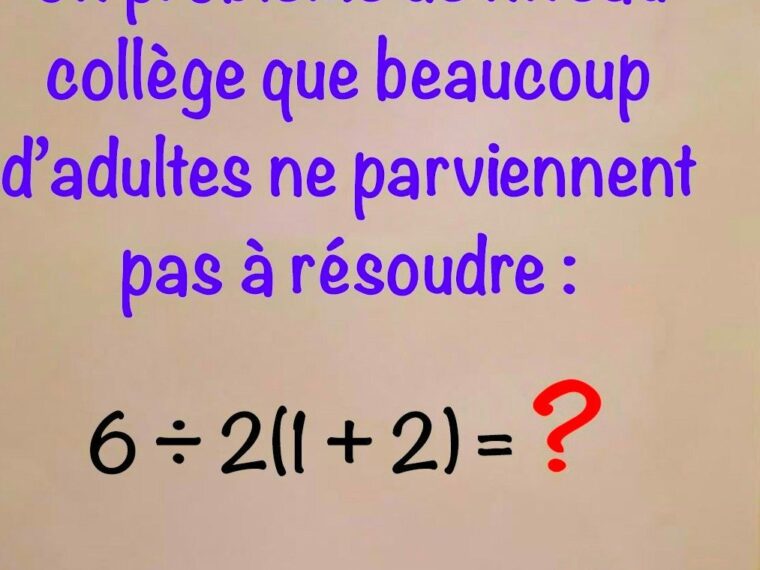
Here’s a classic example pulled straight from an elementary school workbook (roughly a 3rd-grade level in France). At first glance, everyone assumes they can solve it in seconds. Yet once you sit down and start, you quickly realize that the answer isn’t as straightforward as it seems.
Ready? Here’s the problem:
6 ÷ 2(1 + 2) = ?
Did an answer immediately pop into your head?
If your instinctive response was 1, you’re far from alone.
But… that’s not the correct answer.
And that’s where things get interesting.
Why Most People Get This Wrong
This little expression has caused endless debates online. Forums, math teachers, engineers, and even university students have argued over this single line. Why? Because depending on how you interpret the expression, you could end up with two different answers.
The real issue?
Most adults don’t actually remember the order of operations as clearly as they think they do.
Let’s break it down step by step — slowly, clearly, and without assuming anything.
The Order of Operations: PEMDAS (or BODMAS)
You probably remember this from school:
- P – Parentheses
- E – Exponents
- M – Multiplication
- D – Division
- A – Addition
- S – Subtraction
Or depending on where you grew up:
- BODMAS
- Brackets
- Orders
- Division
- Multiplication
- Addition
- Subtraction
But here’s the part most people forget:
👉 Multiplication and division are at the same level.
You solve them from left to right.
Same with addition and subtraction.
This means that in the expression
6 ÷ 2 × something,
you must perform the division first if it appears first from left to right.
And that detail changes everything.
Step 1: Simplify the Parentheses
Let’s start with the simplest part:
1 + 2 = 3
So the expression becomes:
6 ÷ 2(3)
At this point, many adults make a critical mistake. They see 2(3) — which looks like “2 times 3” — and they assume it forms a single block that must be solved before the 6 ÷ part.
But mathematically, unless parentheses or brackets clearly bind the numerator together, the default rule is left-to-right.
So now we have:
6 ÷ 2 × 3
Not:
6 ÷ (2 × 3)
That version would indeed give 1, but it is not what was written in the original problem.
Step 2: Solve from Left to Right
So we go step by step:
- 6 ÷ 2 = 3
- 3 × 3 = 9
Final answer: 9
Yes — the correct answer is 9.
But Why Do So Many Adults Answer “1”?
A big part of the confusion comes from how expressions were printed in old math textbooks. In many older systems, writing 2(3) implied a slightly stronger binding — especially in handwritten math or physics equations. People got used to reading 2(3) as something like “a group,” even when no parentheses actually surrounded it.
This instinct leads many adults to rewrite the expression in their minds as:
6 ÷ (2 × 3)
Which indeed equals:
6 ÷ 6 = 1
But unless parentheses explicitly group 2 and 3 together, that interpretation is incorrect.
The expression 6 ÷ 2(3) must be treated strictly as
6 ÷ 2 × 3.
Most modern math notation, calculators, and programming languages agree with this.
A Problem That Exposes a Deeper Issue
What seems like a simple arithmetic problem actually reveals something deeper about how we learn and forget math concepts. Here’s why the debate persists:
1. Ambiguous Notation in Real Life
Mathematical expressions are sometimes written in ways that are not fully standardized, especially outside of academic contexts. Scientists, engineers, and teachers often rely on context. But without context, we must follow strict rules.
2. Memory vs. True Understanding
Many people learned PEMDAS/BODMAS as a chant rather than a real system. They memorize the letters but forget that some steps share equal priority.
3. Multiplication Next to Parentheses Feels Stronger
When you see 2(3), it visually looks like a tighter pair than “÷ 2”. But math doesn’t care about visual tightness — only actual notation.
4. Calculators Used to Disagree
Older calculators sometimes treated implicit multiplication differently, leading to inconsistent answers. This further confused generations of students.
Putting the Problem Into Context
Next page